The first draft of Cat Skinner is finished and the work of revision has begun. It's going slowly, but serves as a refuge for me to focus on the story in a new way and think about nothing else for a few hours at a time.
I've been doing a lot of driving to transport my sister to doctor appointments and serve as her advocate with doctors and the nursing staff at the Swedish Cancer Institute in Burien and at the Wesley Homes Health Center in Des Moines.
Since my last post in April, LaReta's health has declined. She's gone through radiation in an effort to reduce tumors close to her spine and is on a regimen of shots for cancer which has metastasized into her bones. Her oncologist said, "There is no cure, only treatment."
Unfortunately, the treatment has not eased her pain or chronic nausea which is the worst he's ever seen - and he's been in the cancer business a long time. In an effort to find out what's causing the extreme nausea aside from radiation, chemo therapy and pain pills, he's ordered a brain scan for next week.
The story of Webster Warren Bateman (the Cat Skinner) is also the story of my sister, LaReta, when she was three years old. I'm hoping and praying she'll find some comfort at age 80, in her last days. She already knows I've changed the title to LaReta's Cat Skinner, A Story of Love and Loss in the 1930's. Right now, her story is one of love from her family and our sense of loss at the prospect of her passing.
Showing posts with label Cat Skinner. Show all posts
Showing posts with label Cat Skinner. Show all posts
Thursday, May 12, 2016

Tuesday, April 12, 2016
His Women
The story, Cat Skinner, is not only a story of a
young man finding his way and learning what’s important in life, it’s about the
women who influenced him. There were six. All of these women, whether they
assumed the Bateman name in marriage or were born to it, were survivors whose strength
and perseverance becomes more evident as the story goes on.
Webster
Warren Bateman’s mother, Dena, is initially seen as cold and detached,
preferring her boys stay out of trouble and out of sight. Once you see her life
circumstances in the 1920’s, you understand her motives.
Toots, Webb’s
older sister, and the oldest of six children takes on the role of mother hen to
her wayward brothers and younger sisters. She fills the emotional void Dena can’t
muster because she’s running a hotel and restaurant to keep the family afloat
financially.
Dorothy, Webb’s
first wife, is initially in love with the concept of marriage and family, but
once she experiences the reality of being married to a man whose work comes
first, finds her own strength to survive and make her own way.
Blanche,
Webb’s youngest sister, gives birth at sixteen to a baby boy she gives up for
adoption. Although she regrets her “mistake,” she longs for a relationship with
a child and determines she’ll make something of herself.
Laura, Webb’s
mother-in-law (Dorothy’s mother) has experienced extreme loss, the death of
five of her twelve children, but fights fiercely to raise her granddaughter,
LaReta.
And LaReta, Webb’s
three-year-old daughter, who doesn’t understand her mother’s death, is
determined to “find my mommy.”
While Cat Skinner has an end when LaReta is three-years-old,
her real life story goes on as does her determination. Today, “Lore” as she
nicknamed herself years ago, is nearly 81-years-old. She has survived two
divorces, nervous breakdowns, breast cancer, surgeries, and is now facing the
challenge of bone cancer and its treatment. But she’s focusing on the positive.
Lore has five children of whom she’s very proud, grandchildren whom she adores,
a beautiful home on a hill and she’s managed her finances and her life with
independence and flair. Funny, opinionated, generous, controlling and artistic,
Lore is most of all carrying on the Bateman women’s legacy of strength and perseverance.
Friday, March 11, 2016
Journey
The
difference between the writer and the wannabe writer is … one writes and the
other, due to choice, chance or circumstance, thinks about writing rather than getting
it done. That’s where I’ve been the last couple weeks. Thinking, reading,
procrastinating.
From what I’ve
read and been told, that’s not unusual, but it’s also what keeps a story in one’s
head and not on paper.
I’m now in
Part 3 - The Funeral of Cat Skinner: A Story of Lust,
Love and Loss in the 1930’s. This is the final third of the story. Webb and
his sister, Blanche, have exchanged personal information and experiences as
they motor the 350 miles from Billings, Montana to Dunn Center, North Dakota on
Friday, March 10, 1939. Their goal is to reach Dunn Center by 1 pm in time
for Dorothy’s funeral.
The journey
is more than watching the straight-as-an-arrow highway disappear beneath the
spoke wheels of the 1930 Chevy. It is a journey for Webb to figure out, with
the help of his sister, what kind of man he wants to be, the real thing or a
wannabe. Is he going to think about what he should have done and what he should
do now regarding his three-year-old daughter, LaReta, or is he going to do it.
I’ve been
stuck these past few weeks trying to think my way to the end of the story.
How do I pay homage to the real people who lived this story, show their perspectives, their feelings and fears, in a fictionalized version of the truth? Tonight is the first time I’ve gained a little traction. I'm letting the story tell me where it wants to go.
Hopefully, the story will reveal itself in a way that
readers remain sympathetic to all the characters, including Webb, and in part, to this wannabe
writer, his daughter.
Saturday, February 6, 2016
Getting out of Bed
I woke up
this morning thinking about a response to an exercise I gave the students in my
memoir writing class yesterday. We had discussed the use of sensory
description, dialogue and action in writing about a location where they used to
live.
The exercise was to describe getting out of bed and moving to another room; not just telling about it, but enabling the reader of the story to see what was happening. Show don’t tell – one of the principles of writing. I’m trying to use the principle in the book I’m writing, Cat Skinner: A Story of Lust, Love and Loss in the 1930’s, but here’s my own response to yesterday’s exercise.
 Light
filters through my sheer curtains, teasing my eyes to open. My alarm with its
incessant beeping brings more than a tease to the process. I slap it quiet for
another seven minutes and roll from my left side onto my back. I love
stretching like the cat beside me. Pointing my toes toward the end of the bed, my
elbows are thrust toward the headboard, fists on either side of my neck. Maybe
a strange way to stretch, but it frees spine and muscle kinks until my calf threatens
a Charlie. Not Charlie my dog, but Charlie, my horse. I let up on the toe
pointing and relax, until the muscle spasm subsides, and then return to my
fetal, left side position. Just a few more minutes in this warm, toasty
environment won’t hurt.
Light
filters through my sheer curtains, teasing my eyes to open. My alarm with its
incessant beeping brings more than a tease to the process. I slap it quiet for
another seven minutes and roll from my left side onto my back. I love
stretching like the cat beside me. Pointing my toes toward the end of the bed, my
elbows are thrust toward the headboard, fists on either side of my neck. Maybe
a strange way to stretch, but it frees spine and muscle kinks until my calf threatens
a Charlie. Not Charlie my dog, but Charlie, my horse. I let up on the toe
pointing and relax, until the muscle spasm subsides, and then return to my
fetal, left side position. Just a few more minutes in this warm, toasty
environment won’t hurt.
The alarm beeps again, quietly at first and then louder and louder until I can’t ignore it any longer. One more slap to shut it up. There have been times when I’ve let it go on and on because in a half sleep, dream state, I’ve imagined it was a truck backing up. This morning I got the message without a garbage truck in the room.
I slip my feet off the side of the bed, the rest of me following into an upright position, however reluctant certain body parts are to follow others. My toes slide into my slippers. I sit on the edge of the bed, turn off the alarm, stand up and shake down my older than dirt, purple, granny nightgown. Love the thing. (Girls, feel free to bury me in it. I’m sure you won’t want an open casket anyway, so no one will know the truth of the matter).
Walking to the door of my bedroom and down the hall to the bathroom is dangerous business. The same cat whose stretching I emulate, enjoys weaving in and out of my legs as I walk. While silky soft against my legs, Riley’s erratic movement keeps me guessing about where I step next.
Charlie, my dog, is behind the gate in the utility room, just across from the bathroom. He’s deaf, but when it comes to the possibility of getting fed in the morning, he knows I’m up and with paws up on the gate, in all his Malti-poo cuteness, he whines until I give him what he wants, one-third cup of dog chow. (Of course, he wants more, but unlike me – he’s on a diet).
And so my morning begins - every morning, although now that I’m retired, I must admit, some mornings look more like Noon.
The exercise was to describe getting out of bed and moving to another room; not just telling about it, but enabling the reader of the story to see what was happening. Show don’t tell – one of the principles of writing. I’m trying to use the principle in the book I’m writing, Cat Skinner: A Story of Lust, Love and Loss in the 1930’s, but here’s my own response to yesterday’s exercise.
Light
filters through my sheer curtains, teasing my eyes to open. My alarm with its
incessant beeping brings more than a tease to the process. I slap it quiet for
another seven minutes and roll from my left side onto my back. I love
stretching like the cat beside me. Pointing my toes toward the end of the bed, my
elbows are thrust toward the headboard, fists on either side of my neck. Maybe
a strange way to stretch, but it frees spine and muscle kinks until my calf threatens
a Charlie. Not Charlie my dog, but Charlie, my horse. I let up on the toe
pointing and relax, until the muscle spasm subsides, and then return to my
fetal, left side position. Just a few more minutes in this warm, toasty
environment won’t hurt. The alarm beeps again, quietly at first and then louder and louder until I can’t ignore it any longer. One more slap to shut it up. There have been times when I’ve let it go on and on because in a half sleep, dream state, I’ve imagined it was a truck backing up. This morning I got the message without a garbage truck in the room.
I slip my feet off the side of the bed, the rest of me following into an upright position, however reluctant certain body parts are to follow others. My toes slide into my slippers. I sit on the edge of the bed, turn off the alarm, stand up and shake down my older than dirt, purple, granny nightgown. Love the thing. (Girls, feel free to bury me in it. I’m sure you won’t want an open casket anyway, so no one will know the truth of the matter).
Walking to the door of my bedroom and down the hall to the bathroom is dangerous business. The same cat whose stretching I emulate, enjoys weaving in and out of my legs as I walk. While silky soft against my legs, Riley’s erratic movement keeps me guessing about where I step next.
Charlie, my dog, is behind the gate in the utility room, just across from the bathroom. He’s deaf, but when it comes to the possibility of getting fed in the morning, he knows I’m up and with paws up on the gate, in all his Malti-poo cuteness, he whines until I give him what he wants, one-third cup of dog chow. (Of course, he wants more, but unlike me – he’s on a diet).
And so my morning begins - every morning, although now that I’m retired, I must admit, some mornings look more like Noon.
Saturday, January 23, 2016
Dunn Center, North Dakota

I've never been to Dunn Center, North Dakota, but here it is.
With the assistance of Google Maps, I am able to see the road from Billings, MT northeast along old Highway 10 to Glendive, then east to Dickinson, ND. It gives me a birds eye view of the route my dad, Webster Warren Bateman, and his sister travelled on March 10, 1939 to the funeral of dad's first wife, Dorothy. From Dickinson, they turned north on Highway 22 and then east on Highway 200 to arrive - late - to the funeral at the Normanna Lutheran Church.
In this photo, you can see the location of the church. It's the grey area on the east side of Dunn Center, the right side of the photo. The grey area is parking lot. The north/south road on the far right of Dunn Center leading to the church is the same road where Webb's 1930's Chevy kicked up snow as he put the pedal to the metal (literally) the last mile to the church. Top speed for the vehicle was about 45 miles per hour the entire 350 miles from Billings.
I'm sure the church itself has been remodeled over time, but when I zoomed in I could still see a tall steeple so typical of other Lutheran churches in North Dakota. I have a photo of the small, white wooden church in which Dorothy was confirmed, she and Webb were married, and where on that day in 1939, her funeral service was held. This aerial view shows the same church 77 years later.
March 10, 1939 was a sad day. Dorothy was only 26 years old. She would have been 27 on August 8, 1939. The novel I'm writing, Cat Skinner, A Story of Lust, Love and Loss in the 1930's is not only a story about Webb and Dorothy, but about the other women in his life: his mother Dena, sister Blanche, his three year old daughter LaReta, and another woman - my mother, Julia. It's on the road to Dunn Center and to the church, that the stories of these women unfold in surprising ways.
Friday, January 15, 2016
Stuck in the Middle

At least I
believe I’m in the middle. According to experts, a story has a beginning,
middle and end. Since I haven’t finished the novel, I’m estimating that I’m in
the middle. This is the part of the story when the dramatic arc is supposed to
rise to a crisis point, then dip a bit in terms of action, then rise again to
the climax and recede to the denouement. (Love that word; just fancy and French
for ending or resolution).
Visualize
Mt. Rainier from the Puyallup Valley. I’m climbing up the left side of the
mountain and when I reach the top, there is a double scallop on the way down.
My problem?
I feel I’ve plateaued on the left side of the mountain. I gained traction in Part 1 of the story which is my dad,
Webb’s wild and crazy youth. Now that I’m in Part 2 – His Women, the
women are more sedate and the pace of the story has slowed instead of escalated.
It’s more about the characters than about action.
To get a
better run at the mountain, my tendency has been to retreat to more familiar
territory in chapters previously written. I review and revise, hoping that will
give me inertia to keep moving toward new territory.
I asked my
husband for ideas. His sage advice, certainly not unexpected from Scott was,
“Add sex and violence.” Thanks, Honey Haverly. He may have something there, but
I’m not sure it fits with who ‘His Women’ were.
Dena, Webb’s
mother is 51 years old in this portion of the story. Blanche, Webb’s sister is
almost 21 and riding with him to Dorothy’s funeral; and of course there’s
Dorothy who is lying in a coffin at the end of the journey.
My mountain
is certainly worth climbing, even though the challenge seems daunting. The
answer I’m told - by those who know – Keep going. I’ll give that a try.
Thursday, December 31, 2015
Carbide Lantern
In 1928 at
the age of seventeen, my dad, Webster Warren Bateman, went to work in a coal
mine in New Salem, North Dakota. The historical fiction novel I’m writing, Cat Skinner: A Story of Lust, Love and Loss
in the 1930’s will include this experience and many others during his
youth.
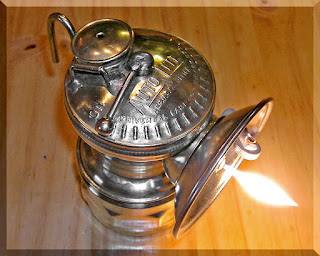 I was
talking to my husband, Scott, about dad’s experience in the mine. This led to a
Google search of Carbide Lantern. What I found gave me a whole new appreciation
for Dad’s own written description about the experience. The lantern, so small it could be held in a man's hand, had two chambers. The bottom was for the solid carbide chips. It screwed into a top chamber that held water. A drip system allowed water droplets to reach the carbide creating acetylene gas. A lever on top of the lantern regulated the length of the flame which came straight out the front, brightened by a round, metal reflector plate behind the flame. Once lit by a spark from a striker wheel on the reflector plate or a match, the lamp gave off a bright, warm light. Still, I can't imagine that as a miner's only source of light 300 feet into the earth. Webb's own words follow:
I was
talking to my husband, Scott, about dad’s experience in the mine. This led to a
Google search of Carbide Lantern. What I found gave me a whole new appreciation
for Dad’s own written description about the experience. The lantern, so small it could be held in a man's hand, had two chambers. The bottom was for the solid carbide chips. It screwed into a top chamber that held water. A drip system allowed water droplets to reach the carbide creating acetylene gas. A lever on top of the lantern regulated the length of the flame which came straight out the front, brightened by a round, metal reflector plate behind the flame. Once lit by a spark from a striker wheel on the reflector plate or a match, the lamp gave off a bright, warm light. Still, I can't imagine that as a miner's only source of light 300 feet into the earth. Webb's own words follow:
 I was
talking to my husband, Scott, about dad’s experience in the mine. This led to a
Google search of Carbide Lantern. What I found gave me a whole new appreciation
for Dad’s own written description about the experience. The lantern, so small it could be held in a man's hand, had two chambers. The bottom was for the solid carbide chips. It screwed into a top chamber that held water. A drip system allowed water droplets to reach the carbide creating acetylene gas. A lever on top of the lantern regulated the length of the flame which came straight out the front, brightened by a round, metal reflector plate behind the flame. Once lit by a spark from a striker wheel on the reflector plate or a match, the lamp gave off a bright, warm light. Still, I can't imagine that as a miner's only source of light 300 feet into the earth. Webb's own words follow:
I was
talking to my husband, Scott, about dad’s experience in the mine. This led to a
Google search of Carbide Lantern. What I found gave me a whole new appreciation
for Dad’s own written description about the experience. The lantern, so small it could be held in a man's hand, had two chambers. The bottom was for the solid carbide chips. It screwed into a top chamber that held water. A drip system allowed water droplets to reach the carbide creating acetylene gas. A lever on top of the lantern regulated the length of the flame which came straight out the front, brightened by a round, metal reflector plate behind the flame. Once lit by a spark from a striker wheel on the reflector plate or a match, the lamp gave off a bright, warm light. Still, I can't imagine that as a miner's only source of light 300 feet into the earth. Webb's own words follow:
One of my
next jobs was for a coal mine in New Salem, North Dakota (1928). My earnings
were the mainstay for the family that winter.
I worked for a few days for free with
another miner to learn how to mine coal. We dug coal rooms working in about 5
inches of water most of the time. We wore the same dirty, crusty long-handled
under-wear, overalls and rubber boots every day. Each man had to get out 10 – 1
ton car loads of coal and a car of slack (fine powder) each day or you got no
bottom cut by a machine that night.
You had to lay a short length of
rail-track and bore the shot holes with a hand auger, make your black powder
shots and load the coal. The mule-skinner brought empty cars to the entrance
and pulled out the loaded cars. The mules lived in the mines until they had to
be changed.
I was only 17 years old, the youngest
miner ever there and maybe the poorest because of lack of experience. I would
almost always be last to ring for the pump-man to lower the cage 300 ft. to
haul me up to the shower room but I’d have my cut out.
We were paid .50 a ton for the coal
mined. The car of slack was free. We furnished the black powder, dynamite and
fuse. Our only light was a carbide lamp fastened to the cap on your head. It
put out about a 2 inch flame. Sometimes it would go out. No one but an old
miner knows what darkness is. You had to make your lamp work again in total
blackness. From then on you know no fear of anything.
Sunday, December 27, 2015
Growing Up On Prairie Farms
 Novelist
Laurence Durrell once said, “It takes a lot of energy and a lot of neurosis to
write a novel. If you were really sensible, you’d do something else.”
Novelist
Laurence Durrell once said, “It takes a lot of energy and a lot of neurosis to
write a novel. If you were really sensible, you’d do something else.”
He was right and it’s why I’m so admiring of an acquaintance of mine, Phyllis Pahl
Mitchell. With the help of my friend and author, Joan Tornow, Phyllis compiled
stories she’d written about growing up in Nebraska in the 1920’s and 30’s. Her paperback
book, Growing Up On Prairie Farms – A Rough
and Tumble Childhood is now available on Amazon.
You can get
a sneak peek at the stories and see this photo of Phyllis on the back cover.
Phyllis, also an accomplished artist, created the artwork. At 93 years young, you
can definitely see the likeness to her father in the beautiful water color. I was
privileged to have taken the photo for the book cover and the other photo of
Phyllis and Joan.
The
compilation of stories in her book was written over a number of years while Phyllis
was a student in Joan’s memoir writing class. She was encouraged to create a
book, but it wasn’t until this fall, with Joan’s editing and design skills,
that Phyllis’ dream became a reality.
 Phyllis’
first person account of life on the farm, attending a rural one-room school and
eventually teaching in a rural school herself shows similarities to characters
in my novel, Cat Skinner: A Story of Lust,
Love and Loss in the 1930’s. It also shows stark contrasts. Phyllis' loving
parents provided guidance and support, while my father, Webb, was tossed out of
his home, not once but twice by his parents, before he was fifteen.
Phyllis’
first person account of life on the farm, attending a rural one-room school and
eventually teaching in a rural school herself shows similarities to characters
in my novel, Cat Skinner: A Story of Lust,
Love and Loss in the 1930’s. It also shows stark contrasts. Phyllis' loving
parents provided guidance and support, while my father, Webb, was tossed out of
his home, not once but twice by his parents, before he was fifteen.
While world
events and environmental changes were the same for these families, the experience
of the children was indeed very different.
My hat is
off to Phyllis and Joan and anyone else who writes their first book. If we were
sensible… But we’re not.
Friday, December 18, 2015
My Father's Life Through a New Lens
Light is a
photographer’s best friend. The more light you have, the better the image will
be. A camera captures light by exposing its internal image sensor. As a
photographer, I have to be mindful of three primary ways of controlling the
amount of light captured: aperture (controls light and focal point), shutter
speed (controls the length of time the sensor is exposed) and ISO (controls the
sensor’s sensitivity to light).
So why talk about photography when I’m attempting to write a novel? Because - I’ve found variables in photography analogous to variables in novel writing. Rivoting – yes?
Probably not, but the project I’ve started, writing the story of my dad’s youth - Cat Skinner: A Story of Lust, Love and Loss in the 1930’s, is full of discovery. The excitement I felt when I decided to seriously pursue photography is what I’m feeling now in writing his story. (I just discontinued photography as a business after six wonderful years. www.BonnieKingPhotography.com).
The similarities are many. I’m seeing my father’s life through a new lens. The light I’m seeking is provided by those who have written successful novels and those who have written technical works on how to write a successful novel. And here again, there are three primary variables: character (without whom there is no story), plot (which the writer must imagine) and structure (the way in which the plot unfolds).
Of course, there’s much more to photography than light and camera settings and there’s certainly more to novel writing than character, plot and structure. Both the photographer and the writer must have an idea of the desired result, be able to creatively compose subject matter, add special effects and then crop to assure the real story of the subject is told.
I was able to produce photo results that were pleasing to me and I hope to my photography clients. (I received rave reviews from many).
Whether I can do the same with this novel remains to be seen, but like photography, the challenge of learning and the journey itself, are well worth the effort.
So why talk about photography when I’m attempting to write a novel? Because - I’ve found variables in photography analogous to variables in novel writing. Rivoting – yes?
Probably not, but the project I’ve started, writing the story of my dad’s youth - Cat Skinner: A Story of Lust, Love and Loss in the 1930’s, is full of discovery. The excitement I felt when I decided to seriously pursue photography is what I’m feeling now in writing his story. (I just discontinued photography as a business after six wonderful years. www.BonnieKingPhotography.com).
The similarities are many. I’m seeing my father’s life through a new lens. The light I’m seeking is provided by those who have written successful novels and those who have written technical works on how to write a successful novel. And here again, there are three primary variables: character (without whom there is no story), plot (which the writer must imagine) and structure (the way in which the plot unfolds).
Of course, there’s much more to photography than light and camera settings and there’s certainly more to novel writing than character, plot and structure. Both the photographer and the writer must have an idea of the desired result, be able to creatively compose subject matter, add special effects and then crop to assure the real story of the subject is told.
I was able to produce photo results that were pleasing to me and I hope to my photography clients. (I received rave reviews from many).
Whether I can do the same with this novel remains to be seen, but like photography, the challenge of learning and the journey itself, are well worth the effort.
Monday, December 14, 2015
Interruptions
One of the
books I’m reading as a guide to my writing suggests, “Don’t ever stop. Even if
you can only peck out a hundred words a day (anybody can peck out a hundred
words in a day – and if you say you can’t then you really don’t have what it takes,
so quit now).” James Scott Bell in Revision
and Self-Editing for Publication, Second Edition.
Well, I’m
not about to quit work on Cat Skinner: A
Story of Lust, Love and Loss in the 1930’s, but there are days when I don’t
write. Fortunately this same author also advises that if you hit a wall (His is
around 30,000 words. Mine is every 2,000!), take one whole day off.
Truthfully,
my days off are for reasons other than hitting a wall. Sometimes it’s plain and
simple procrastination. Some days, it’s because I have other passions to
pursue, people to care for, and coffee klatches I can’t miss!
This past
month there have been plenty of excuses to skip writing days: A radio interview
with Dorothy Wilhelm about Friends At Your Metro Animal Shelter (FAYMAS), a FAYMAS
Board meeting and taking photos of the animals at the Metro Animal Shelter.
Then there
was Thanksgiving at Scott’s niece’s home near Key Center, a fabulous wedding
rehearsal dinner in Tacoma, Scott’s son Steve’s wedding (at which Scott
announced to all attendees that my daughter, Kendall, is pregnant with her
third child, as part of his toast to Steve and Kelli. That man! He said it just
came out.)
Seattle
doctor appointments for Scott filled two full days. By the way, he’s doing
great which means I have to endure bad jokes all the way to and from his
appointments and have my driving corrected every three minutes. (He’s driving
the next time to keep from driving me crazy).
To assuage
my guilt for not writing every day, I did attend a Plateau Area Writers’
Association meeting to hear Donna Seebo speak, my writer’s group monthly get
together that always results in rewrites for me, and I stopped by the Sumner
Library to hear Dorothy Wilhelm talk about her newest book, Better Every Day. It’s a compilation of
some of her 25 years of humorous Tribune newspaper columns.
Coffee
klatches certainly have their place in interrupting my writing. Had coffee with
my photographer friend, Jessie; lunch with friend and VP of FAYMAS, Chris;
coffee with neighbor Janine; breakfast with all my WIT (Women in Transition) friends at Charlie’s
Restaurant; and just had coffee this morning with friend Shelly (she makes the best eggnog!).
Can’t forget
to mention - babysitting my two grandchildren, Micah and Gracie, a number of
times this month. I just found out this
week that they have an “incredible” cobweb hanging from their ceiling light. It
told Kendall she has definitely trained them right – to see delight where
others might see need for a broom.
Interruptions?
Not really. How blessed I am to have such a rich and rewarding
life.
Friday, December 11, 2015
The Objective - What Does Webb Want?
(Note: If
you are receiving this as an email, the paragraph spacing is not accurate. For
a better view, click on the title to see the actual blog post).
The Wordsmith’s met Wednesday evening. This is my writing group that meets once a month. I share a couple chapters of Cat Skinner with them a week before we meet. The other members do the same and we critique each other’s work. The group: Phebe, Renee, Judy and two new members, Sabrina and Sydney (mother/daughter), has provided me with invaluable feedback.
This week’s suggestions included moving chapters around to better prepare readers for the maturity of my father, Webb, who at the age of 12 in 1923 had a sexual encounter with a teenage girl slightly older than he was. While the scene was written in a humorous way, concerns were expressed by the group about the girl taking advantage of Webb. That’s certainly giving me pause to think about doing some rewriting. As I understand it from the little (very little) my father wrote about it, it was quite innocent.
There were also suggestions that Dorothy, Webb’s wife, be introduced as a more fully developed character earlier in the story.
I’m coupling group feedback with information from James Scott Bell’s book, Revision and Self-Editing for Publication (Second Edition). This has me writing out what I believe was Webb’s objective in life from the time he was first sent away from home to the end of my novel when he was 28 years old. Understanding his objective (what did he want) will help me develop the plot line (what happens to Webb), the structure (where to place incidents along the plot line), and how best to end the story. I also have relatives who may be checking the actual chronology of events!
In the end, I have to figure out:
The Wordsmith’s met Wednesday evening. This is my writing group that meets once a month. I share a couple chapters of Cat Skinner with them a week before we meet. The other members do the same and we critique each other’s work. The group: Phebe, Renee, Judy and two new members, Sabrina and Sydney (mother/daughter), has provided me with invaluable feedback.
This week’s suggestions included moving chapters around to better prepare readers for the maturity of my father, Webb, who at the age of 12 in 1923 had a sexual encounter with a teenage girl slightly older than he was. While the scene was written in a humorous way, concerns were expressed by the group about the girl taking advantage of Webb. That’s certainly giving me pause to think about doing some rewriting. As I understand it from the little (very little) my father wrote about it, it was quite innocent.
There were also suggestions that Dorothy, Webb’s wife, be introduced as a more fully developed character earlier in the story.
I’m coupling group feedback with information from James Scott Bell’s book, Revision and Self-Editing for Publication (Second Edition). This has me writing out what I believe was Webb’s objective in life from the time he was first sent away from home to the end of my novel when he was 28 years old. Understanding his objective (what did he want) will help me develop the plot line (what happens to Webb), the structure (where to place incidents along the plot line), and how best to end the story. I also have relatives who may be checking the actual chronology of events!
In the end, I have to figure out:
1. Did Webb gain his objective (happy
ending)
2. Lose his objective (unhappy ending)
3. Gain his objective but lose something
more valuable (classic tragedy)
4. Sacrifice his objective for the
greater good
5. Is the ending ambiguous or
bittersweet
Regardless
of all this, I am gaining more insight into my father’s life than I ever thought
possible. He spent a lifetime trying to prove he was worthy and ended up
hurting a number of people along the way.
Monday, December 7, 2015
Giraffe Jargo
“Jeezus christ,
Webb!” Shorty screamed as the truck careened over the side of the road and into
a ditch. The load of poles shifted and caused the old Model T to buck and sway
like a bronco.
Webb sprang back to life. He’d closed his eyes for a second, but that was all it took for the truck to head off the road. He cranked the wheel slowly back to the left, shifted down and gave the unwieldy, top heavy rig enough gas to get her back on the road.
Webb sprang back to life. He’d closed his eyes for a second, but that was all it took for the truck to head off the road. He cranked the wheel slowly back to the left, shifted down and gave the unwieldy, top heavy rig enough gas to get her back on the road.
“Want to get
us killed, kid! That’s a sure way to do it. Good thing we’re not hauling the
dogs or ponies. They’d be kickin’ shit about now.”
“Hey,
Shorty, Good thing you don’t weigh more or it woulda been all on you. Get it?”
Webb grinned sheepishly.
“Look. I’ve
been with a lot of these small time circuses and managed to survive. I don’t
want my headstone to read, ‘Shorty – Mighty Midget bought the farm at the
bottom of a pile of Big Top tent poles."
“Awe, come
on. I was just catchin’ a couple winks. Can’t blame a guy, can you? We work
from first light, way past midnight, get only four or five hours sleep a night.
How’s anybody s’pose to stay awake under these conditions?”
“You’ll be
awake alright when you and your brother are hitchin’ it down the road without a
job and probably without pay either. Good ole Honest Bill’s been known to leave
roustabouts in the dust, if he doesn’t like somethin’ or somebody. Good thing
we’re the last truck or you would be hoofin’ it in short order. Not a pretty
thought in the heat of summer in the middle of goddamn nowhere, South Dakota.”
###
This
is the circus chapter's opening scene (at least for now) in Cat
Skinner, A Story of Lust, Love and Loss in the 1930's. I admit, writing
this chapter is intimidating. It may be because there is
such richness of possibility with the characters, the setting and where I
might go with the story line. It's not a case of writer's block, it's a case of
obsession with the research!
Last
week and this I've spent time contacting a book distributor, publisher and an
author to get permission to use a photo of a giraffe jargo. My dad and his
brother, Ray, were the two humans in a giraffe suit led around the Big
Top by a clown. Since the circus was small, everyone had multiple jobs.
Webb and Ray, as roustabouts, also put up the circus, took it down and
drove it from town to town the summer of 1925.
So
far I've only found dead ends in terms of legally using the photo.
But the author did give me other suggestions for where to find other
photos. I've started that search today. As a photographer myself, I'm
hoping to share the visuals of my dad's story as well as the story. But now
it's time to keep writing.
Thursday, December 3, 2015
How Can You Ever Forget Old Norway - Kan du glemme gamle Norge?
There is a Christmas party scene in Cat Skinner: A Story of Lust, Love and Loss in the 1930's where the majority of the attendees are immigrants from Norway or descended from immigrants.
As a child, I can remember my Dad, Webster Warren Bateman, singing this song in Norwegian. The only part of the song I remembered was the first line which is also the title. Thanks to my cousin, Janet Peterson Esser, I now have all the words in both Norwegian and English.
I'm sharing them here because this blog will eventually become my personal book of memories of what it took to write my first novel. It's an eye-opening, sometimes heartwarming (this song for example) and surprising look at who my father was as a young man.
Kan du glemme gamle Norge? Norwegian – American Folksong
1. How can you ever forget Old Norway? I can never forget that country, with its proud castle-like mountains
 is and will remain my native land.
2. How can you forget this country which first embraced you? Do you think you’ll ever find another country with such a proud and glorious name?
3. How can you ever forget Norway’s forests with their pines, and birches and firs? If you can forget the waves of the ocean, then you are able to forget everything.
4. How can you forget these narrow fjords which twist and turn? There as a child you often were rocked by a stiff breeze.
5. Don’t your thoughts at times take flight to the place your cradle stood? Don't you feel your heart is beating for the land you left behind?
6. Let, Oh let your thoughts take flight; let them fly so easily. Long live Old Norway, forever young, in the hearts of all Norwegians.
1. Kan du
glemme gamle Norge ?  Aldri jeg det glemme kan,
  som med stolte klippeborge er
og blir mitt Ødeland.
som med stolte klippeborge er
og blir mitt Ødeland.
2. Kan
du glemme dette landet som dig først tok i sin favn ? Mon du finne vil et annet
med så stolt og herlig navn?
Kan
du glemme dette landet som dig først tok i sin favn ? Mon du finne vil et annet
med så stolt og herlig navn?
3. Kan du glemme Norges skover med sin furu, birk og gran ? Kan du glemme sjØens vover, alt du da forglemme kan.
4. Kan du glemme disse trange fjorde, som sig bukter inn ? Hvor som barn du mange gange vugget dig for førlig vind.
5. Svever stundom ei din tanke dithen hvor din
vugge stod ? Føler du ei hjertet banke for det land som du forlot?
Svever stundom ei din tanke dithen hvor din
vugge stod ? Føler du ei hjertet banke for det land som du forlot?
6. La da kun din tanke sveve; det kan aldri falle tungt. Må for nordmenn
lenge leve.
det kan aldri falle tungt. Må for nordmenn
lenge leve.
1. How can you ever forget Old Norway? I can never forget that country, with its proud castle-like mountains
is and will remain my native land.2. How can you forget this country
which first embraced you? Do you think you’ll ever find another country with such a proud and glorious name?3. How can you ever forget Norway’s forests with their pines, and birches and firs? If you can forget the waves of the ocean, then you are able to forget everything.
4. How can you forget these narrow fjords which twist and turn? There as a child you often were rocked by a stiff breeze.
5. Don’t your thoughts at times take flight
to the place your cradle stood? Don't you feel your heart is beating for the land you left behind? 6. Let, Oh let your thoughts take flight; let them fly so easily. Long live Old Norway, forever young, in the hearts of all Norwegians.
Aldri jeg det glemme kan, som med stolte klippeborge er
og blir mitt Ødeland. 2.
Kan
du glemme dette landet som dig først tok i sin favn ? Mon du finne vil et annet
med så stolt og herlig navn?3. Kan du glemme Norges skover med sin furu, birk og gran ? Kan du glemme sjØens vover, alt du da forglemme kan.
4. Kan du glemme disse trange fjorde, som sig bukter inn ? Hvor som barn du mange gange vugget dig for førlig vind.
5.
Svever stundom ei din tanke dithen hvor din
vugge stod ? Føler du ei hjertet banke for det land som du forlot? 6. La da kun din tanke sveve;
det kan aldri falle tungt. Må for nordmenn
lenge leve.
Subscribe to:
Posts (Atom)